
Showing posts with label GlyFlo Technology. Show all posts
Showing posts with label GlyFlo Technology. Show all posts
Wednesday, November 16, 2016

Friday, October 7, 2016
QD Syringe | QD Syringe Systems | The Next Generation Low Dead Space Syringe

A New Syringe Designed for greater Dose Control
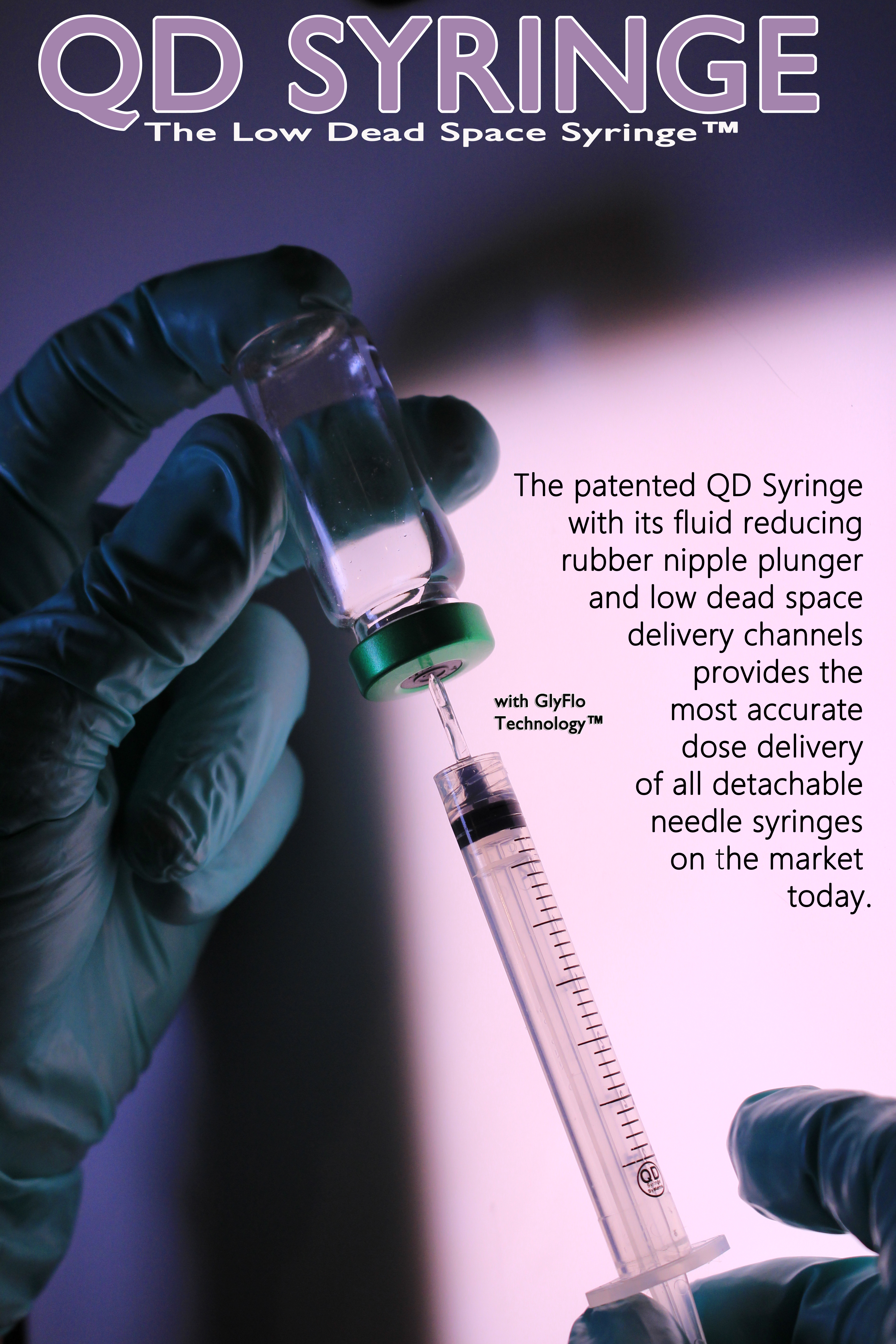
The patented design of the QD Syringe includes several innovative concepts that also help make it one of the most versatile syringe products available. The QD Syringe consists of a patented cone tip with GlyFlo Technology™ designed as a ready to use draw down needle, eliminating time, needle dulling, hazardous waste and additional inventory ~ Unique bilateral fluid flow channels for easy draw and delivery of viscous liquids ~The QD Syringe is compatible with existing Luer Lock Hubs ~ The QD Syringe has a low dead space mating needle Hub available for up to 20 needle gauge sizes.For More information contact: Christopher Green at: QuickDrawSyringe@gmail.com
www.QDSyringe.com
www.QDSyringeSystems.com
Thursday, May 10, 2012
How To Dispose Of A Contaminated Needle
DOs and DON'Ts of Proper Sharps Disposal
- DO immediately place used needles and other sharps in a sharps disposal container to reduce the risk of needle sticks, cuts or punctures from loose sharps.
- DO use an FDA-cleared sharps disposal container, if possible. If an FDA-cleared container is not available, some organizations and community guidelines recommend using a heavy-duty plastic household container as an alternative.
- DO make sure that if a household container is used, it has the basic features of a good disposal container.
- DO carry a portable sharps disposal container for travel.
- DO follow your community guidelines for getting rid of your sharps disposal container.
- DO call your local trash or public health department (listed in the county and city government section of your phone book) to find out about sharps disposal programs in your area.
- DO ask your health care provider, veterinarian, local hospital or pharmacist
- where and how to get an FDA-cleared sharps disposal container,
- if they can dispose of your used needles and other sharps, or
- if they know of sharps disposal programs near you.
- DO keep all sharps and sharps disposal containers out of reach of children and pets.
- DO seal sharps disposal containers when disposing of them, label them properly and check your community guidelines on how to properly dispose of them.
- DO ask your medical or prescription insurer whether they cover sharps disposal containers.
- DO ask the manufacturer of your drug products that are used with a needle or other sharps if they provide a sharps disposal container to patients at no charge.
- DO report a problem associated with sharps and disposal containers.
- DON’T throw loose needles and other sharps into the trash.
- DON’T flush needles and other sharps down the toilet.
- DON’T put needles and other sharps in your recycling bin -- they are not recyclable.
- DON’T try to remove, bend, break, or recap needles used by another person. This can lead to accidental needle sticks, which may cause serious infections.
- DON’T attempt to remove the needle without a needle clipper because the needle could fall, fly off, or get lost and injure someone.
- www.QDSyringeSystems.com
- www.QDSyringe.com
Thursday, December 8, 2011
Needlestick Injuries, Legislation and More...

* "Today alone over 2,100 health care professionals will incur a needlestick related injury." [NIOSH Study, 1999]
* There have been 57 documented cases of HIV seroconversion among healthcare personnel
* The cost of needlestick injury follow-up in the U.S. per incident is around $3,000.
* Accident follow ups cost the US medical industry $1.2 billion annually.
* Annual treatment for contracted diseases in the US is $1.8 billion.
* A total of $3 billion is spent annually in the US on needlestick injuries.
* In the United Kingdom the number of reported needlestick injuries has risen 49% from 2002 to 2005 (Article – The Times), presently estimated at more than 100,000 per year.
* Thousands of Australian hospital workers suffer needlestick injuries each year and the incidence is increasing.
Global Legislative Outlook
* The United States already has OSHA legislation in place requiring the use of safety injection technology.
* US military planning a policy shift to safety technology
* Spain has begun mandating use of safety technology with a 3-5 year implementation period.
* EU Legislation is pending due to a ground swell of protest from healthcare workers who are concerned about the risk of suffering bloodborne pathogen induced illnesses (eg: Hepatitis B, Hepatitis C and HIV / AIDS) as a direct result of needlestick injury.
* In the UK, the NHS is assessing all suitable safety technology. The transition to safety devices began in 2006.
* Australia and Canada are reviewing policies and are expected to mandate safety technology in the next two-three years.
From Q Stat Safety Syringe
Subscribe to:
Posts (Atom)